
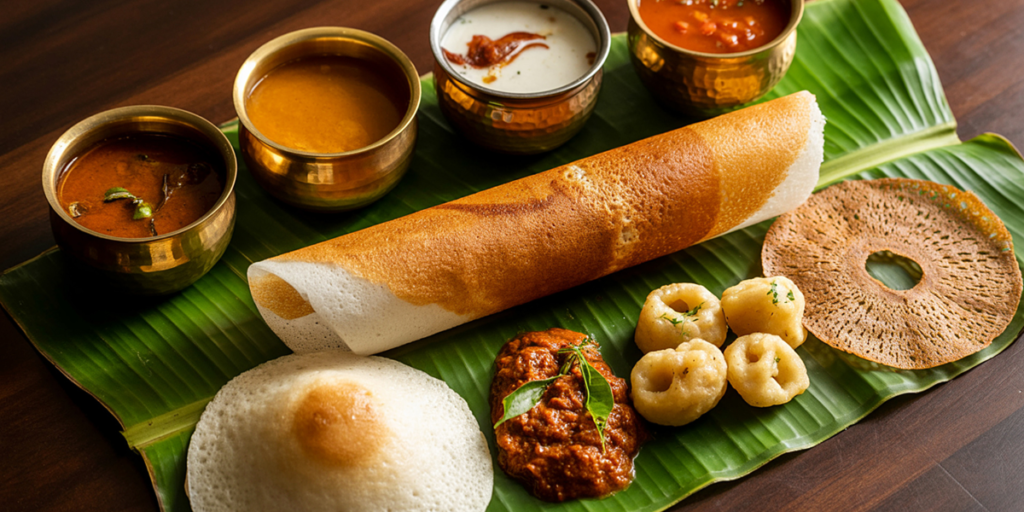
Dosa has become one of the most recognized South Indian dishes on the global food map. A crispy, paper-thin crepe made from fermented rice and lentil batter, it appears simple at first, yet the dish has inspired many variations over time.
Indian cuisine consistently ranks among the top 10 most searched cuisines worldwide, and dosa sits right at the center of that growing interest. Restaurants across many countries now feature different dosa styles on their menus.
South Indian cuisine offers several versions, and the debate around Egg Dosa vs Masala Dosa often surprises new food lovers. Both remain among the most ordered options in many restaurants.
Masala dosa comes with a crisp crepe filled with spiced potato masala. Egg dosa adds a freshly cracked egg that cooks directly on the dosa, giving it extra richness and protein.
The base stays the same for both. The difference appears in the topping and the flavor experience that follows.
The real question is which one suits your taste, appetite, and expectations from a meal. This guide breaks down the differences to help you decide which dosa deserves a place on your plate.
Egg Dosa, known as Muttai Dosa in Tamil, is a South Indian street food that started on the busy food streets of Tamil Nadu and has since traveled across South India and beyond.
At its core, it is the same fermented rice and lentil batter used for any classic dosa. It combines the crisp texture of traditional dosa with the richness of a freshly cooked egg. A whole egg gets cracked directly onto the hot crepe while it cooks on the griddle. The egg spreads across the surface and cooks into the batter, creating a flavorful layer that adds protein, texture, and depth.
Dosa itself has roots going back to at least the first century CE, with food historian K.T. Achaya tracing references to it in ancient Tamil literature. Egg Dosa takes that centuries-old base and gives it a modern, protein-forward upgrade.
The process begins with a fermented batter made from soaked rice and urad dal, ground smooth and left to ferment overnight. That fermentation step is what gives the dosa its signature light texture and subtle tang.
A ladle of batter is spread onto a hot greased griddle to form a thin dosa. Before the batter fully sets, a fresh egg is cracked directly into the center and the yolk is broken and spread across the surface. From there, the toppings go on, finely chopped onions, green chilies, fresh coriander leaves, and a sprinkle of spice powder known as idli podi.
The dosa cooks until the bottom turns golden and crisp. It is then folded and served hot, straight off the griddle.
The texture of the Egg Dosa stands apart from a plain dosa. The outer edges are thin and crackling. The center, where the egg sits, stays slightly softer and denser. Pressing the toppings into the egg layer while it cooks creates a surface that is textured, layered, and satisfying to bite into.
Egg Dosa is best served hot, straight off the pan. The crispiness fades quickly, so it is always made on order, which is exactly why street vendors across Tamil Nadu keep their griddles going all day long.
For US food lovers paying attention to what they eat, Egg Dosa holds up well as a balanced meal.
A single serving of around 150 grams delivers approximately 250 calories, 10 grams of protein, 10 grams of fat, and 30 grams of carbohydrates. The egg contributes vitamins B12, A, and D alongside healthy fats, while the fermented batter adds iron, fiber, and natural probiotics that support gut health.
It provides a complete balance of protein, carbohydrates, and essential nutrients, which make it a solid breakfast option that keeps the body fueled without sitting heavy.
Masala Dosa is one of the most recognized dishes to come out of South India, a thin, crispy rice and lentil crepe wrapped around a warm, spiced potato filling and served alongside coconut chutney and sambar.
It is a complete meal in itself. And for millions of people across South Asia and now the US, it has been a breakfast table staple for generations.
The origin of Masala Dosa has more than one story behind it, and food historians have debated it for years.
The dosa itself dates back over 1,500 years to Tamil Nadu, as referenced in ancient Sangam literature. The Masala Dosa, as a distinct dish, however, emerged from Karnataka’s Udupi region in the 20th century.
The potato filling is believed to have originated in the temples of Udupi, introduced by resourceful temple cooks during times when rice was scarce, and potatoes were more affordable, as a way to make the dosa more filling and substantial.
The dish was later popularized in Madras, now Chennai, during the 1930s by restaurateur K. Krishna Rao, who operated the Udupi-style Sri Krishna Vilas Hotel on Mount Road and later the New Woodlands Hotel.
He is widely credited with bringing Masala Dosa to a broader audience and cementing its place in South Indian food culture.
Another story traces it to the royal kitchens of the Mysore Maharaja. After an extravagant palace gathering left behind significant food, the Maharaja asked his cooks to find a creative use for the leftovers. They stuffed the remaining spiced potatoes into plain dosas, and Masala Dosa was born.
No single origin has been officially confirmed. What is certain is that the dish traveled fast from temple kitchens and palace halls to street corners and restaurant menus across the country and beyond.
The process starts the night before the dosa ever hits the griddle.
Rice and urad dal are soaked separately, then ground into a smooth batter and left to ferment overnight. This fermentation process, influenced by temperature and humidity, enhances both the flavor and the digestibility of the batter.
The potato filling is prepared separately. Boiled potatoes are mashed and cooked down with mustard seeds, curry leaves, turmeric, green chilies, onions, and fresh coriander. The result is a warm, aromatic masala that sits at the heart of every good Masala Dosa.
When the griddle is hot, a ladle of batter goes on and gets spread in a wide, thin circle. Oil or ghee drizzles along the edges as it cooks, building the crisp golden base. The potato filling goes in at the center, and the dosa folds over it before being served immediately.
Masala Dosa is best consumed fresh for the best texture and taste, as the cooked dosa loses its crispness quickly.
For health-conscious food lovers across the US, Masala Dosa holds up well as a balanced and satisfying meal.
A standard Masala Dosa of around 150 grams delivers approximately 220 calories, 6 grams of protein, 38 grams of carbohydrates, and 8 grams of fat. The fermented batter contributes natural probiotics that support gut health, while the lentils in the batter add iron, B vitamins, and fiber.
The batter is the same. The griddle is the same. But from the moment the toppings and fillings enter the picture, Egg Dosa and Masala Dosa head in completely different directions.
Here is a detailed look at how the two stack up against each other.
Egg Dosa leads with a savory, protein-rich flavor that is mild at its base but builds heat through the onions, green chilies, and idli podi scattered across the egg layer. The fermented batter adds a gentle tang underneath it all. The overall flavor is bold, direct, and satisfying without being overwhelmingly spicy.
Masala Dosa is warmer and more aromatic. The spiced potato filling carries turmeric, mustard seeds, and curry leaves that release a deep, earthy flavor. The spice level is present but controlled. The coconut chutney and sambar served alongside add layers of coolness and tang that balance the whole experience.
The two dishes share their base but part ways completely after that.
Egg Dosa adds:
Masala Dosa adds:
One builds its flavor on top of the dosa. The other tucks its filling inside.
Both dosas are thin, golden, and crispy at the edges. The difference shows up in the center.
Egg Dosa has a textured, slightly dense center where the egg has cooked directly into the batter. The surface is uneven in the best way, crispy at the edges, layered through the middle, with visible bits of onion and coriander pressed into the egg. The color runs from golden brown at the base to a pale, cooked egg white across the top.
Masala Dosa is more uniform in appearance. The outside is a consistent golden brown with a smooth, crackling surface. The filling stays hidden inside until the dosa is broken open, revealing the warm yellow potato masala at the center.
Egg Dosa is the better pick for:
Masala Dosa works best for:
Both dishes have found a strong presence across the US, particularly in cities with established South Indian food communities.
Masala Dosa has a wider reach. It appears on nearly every South Indian restaurant menu across New York, Houston, San Jose, Chicago, and Atlanta and is often the first dosa a new customer tries. Many North Indian restaurants also carry it, which has helped it reach a broader audience beyond dedicated South Indian eateries.
Egg Dosa is more of a specialty find. It shows up consistently in authentic South Indian restaurants, street food pop-ups, and Indian food festivals. Its growing popularity among food-forward diners in the US has pushed more restaurants to add it to their menus in recent years.
Both Egg Dosa and Masala Dosa deserve a spot on your plate, but for different reasons.
Egg Dosa is the right choice if you want something bold, protein-rich, and packed with street food energy. The crispy base, the cooked egg layer, and the heat from the chilies and idli podi make it a deeply satisfying meal that fuels you through the morning.
Masala Dosa is the better fit if you are after something warm, aromatic, and complete. The spiced potato filling, the coconut chutney, and the sambar alongside turn it into a full, structured meal that feels comforting from the first bite to the last.
First time trying dosa? Start with Masala Dosa to understand what the dish is built on. Once you understand the taste, Egg Dosa can be the natural next step because it is bolder, spicier, and just as rewarding.
Egg Dosa and Masala Dosa both come from the same humble batter, the same griddle, and the same rich South Indian food tradition.
What sets them apart is not just the ingredients. It is the experience each one delivers. Egg Dosa brings boldness, protein, and a street food energy that is hard to match. Masala Dosa brings warmth, comfort, and a centuries-old flavor profile that has stood the test of time for good reason.
Neither one is better than the other. They serve different moods, different appetites, and different moments in the day.
The best way to settle the debate is simple, try both. Order the Masala Dosa first, understand the classic, then come back for the Egg Dosa. Once you have had both fresh off a hot griddle, the choice becomes a lot more personal than anyone else’s recommendation.
Have Questions? We’ve Got Answers!
Yes, the base batter is identical for both. The difference lies entirely in what gets added during and after cooking. The fermented rice and urad dal batter is the foundation of every dosa variation, regardless of the toppings or filling.
Yes. Many restaurants offer a vegetarian take that replaces the egg with paneer or a spiced vegetable mix spread across the dosa in the same style. The texture and cooking method stay the same, only the topping changes.
The grinding process takes about 30 minutes, but the batter needs to ferment for at least 8 to 12 hours before it is ready to use. Most home cooks prepare it the night before and cook fresh dosas the following morning.
Yes. The batter is made entirely from rice and lentils, both of which are naturally gluten-free. The potato filling is also gluten-free. It is one of the reasons Masala Dosa has gained popularity among gluten-sensitive diners across the US.
Idli podi, also called gunpowder, is a dry spice blend made from lentils, dried chilies, sesame seeds, and curry leaves. It is widely available at Indian grocery stores across the US and on major online retailers.