
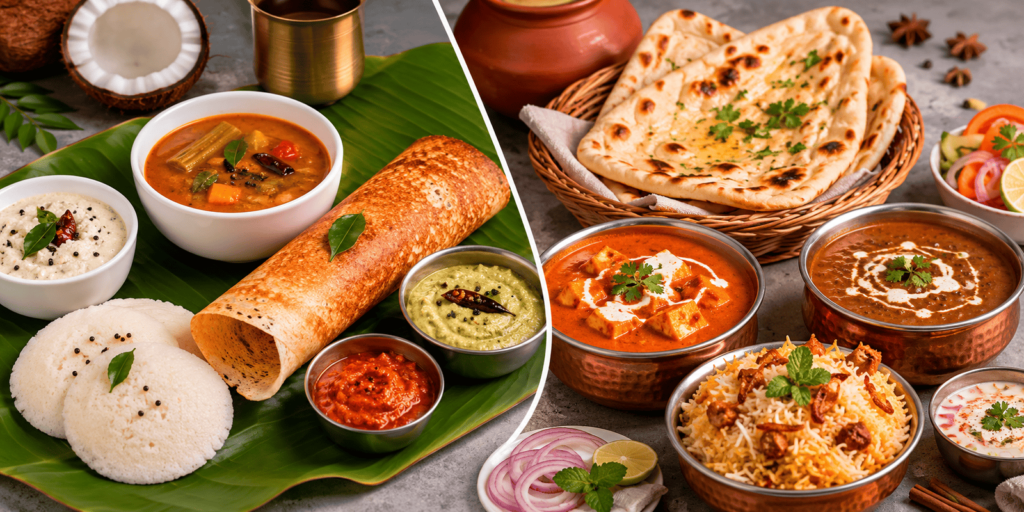
India’s food culture is incredibly diverse, and nowhere is that more obvious than in the contrast between South Indian and north Indian cuisine. Although both trace back to the same country, the two regions cook, season, and serve food in completely different ways.
If you’ve ever wondered why a plate of biryani in the north tastes nothing like the rice dishes served in the south, or why dosas dominate breakfast tables below the Deccan Plateau while naan rules dinner above it, you’re not alone. At Indian Flavors USA in Wylie, TX, we serve dishes inspired by both traditions on our full menu, so understanding the differences can help you decide exactly what to order next. Here’s a complete breakdown of how south Indian and north Indian cuisine differ, and where the two traditions overlap.
Geography plays a huge role in shaping India’s two major culinary traditions. North India covers states like Punjab, Delhi, Uttar Pradesh, and Rajasthan, a wheat-growing belt with a climate suited to dairy farming and centuries of Mughal and Persian influence. That history is exactly why north Indian kitchens lean on tandoors, cream, ghee, and slow-braised meat dishes.
South India, on the other hand, includes Tamil Nadu, Kerala, Karnataka, and Andhra Pradesh. This region is a rice-growing, coastal area with abundant coconut palms, tamarind, and curry leaves. The result is a cuisine built around steamed and fermented rice batters, coconut-based gravies, and bold, tangy heat. Once you understand this geographic split, every other difference on this list starts to make sense.
The single biggest difference between these two cuisines comes down to the staple grain. North Indian meals are built around wheat: rotis, parathas, and naan are used to scoop up curries and dals. South Indian meals are built around rice, often fermented and steamed into dishes like idli, dosa, and uttapam. If you want to see this contrast firsthand, our Egg Dosa vs. Masala Dosa guide breaks down how a single South Indian staple can be prepared in very different ways.
North Indian cooking relies heavily on garam masala, ghee, cream, and slow-cooked tomato-onion gravies. The heat is usually moderate, balanced out by dairy and richness rather than sharp spice. Dishes like butter chicken and dal makhani are the perfect example of this approach: warm, rounded, and comforting.
South Indian cooking takes a different path entirely. Mustard seeds, curry leaves, dried red chilies, and tamarind create a tempering process known as tadka, which forms the flavor base of most dishes. Coconut, both fresh and as oil, adds richness without dairy, and fermentation (as in dosa and idli batter) adds a tangy depth you won’t find up north. Our breakdown of perfectly spiced Indian and Pakistani cuisine goes deeper into how these spice-layering techniques actually work.
North Indian kitchens are famous for the tandoor, a clay oven used to char naan and skewer meats like chicken tikka at extremely high heat. Curries are often simmered slowly (a technique called dum) to let spices fully infuse the dish, and dairy products like paneer, cream, and ghee appear constantly.
South Indian kitchens favor steaming, fermenting, and quick stovetop tempering instead. Idli is steamed, dosa is griddled thin, and sambar or rasam are simmered briefly rather than for hours. Coconut oil frequently replaces ghee, especially along the coast, giving South Indian food a lighter, brighter finish.
Most diners’ first introduction to Indian food is actually north Indian. Familiar dishes include:
Curious how these dishes compare? Take a look at our guides on why Indian Flavors USA serves the best butter chicken and our Chicken Biryani Guide for the full origin story behind two North Indian favorites.
South Indian food tends to be lighter, tangier, and built around rice and lentils. Classic dishes include:
If dosa is new to you, our Egg Dosa vs. Masala Dosa comparison is the easiest way to figure out which version fits your taste before you order.
Sides reflect the same north-south divide. North Indian meals come with a basket of breads (roti, paratha, naan) alongside pickles like mango achar and cooling raita. South Indian meals lean on rice in different forms, including lemon rice, coconut rice, and curd rice, paired with coconut chutney and spicy podi (a dry spice powder). Neither approach is more authentic than the other; they’re simply two different ways of completing a plate.
If you eat vegetarian, South Indian cuisine is naturally suited to you. Dishes like idli, dosa, sambar, and coconut-based vegetable curries were never built around meat to begin with, which makes the South Indian menu one of the most vegetarian-friendly food traditions in the world. Explore our traditional vegetarian Indian dishes guide or check out our vegetarian entrées to see what’s available.
Dessert follows the same regional split. North Indian sweets like gulab jamun, jalebi, and kheer are typically dairy-based and syrup-soaked. South Indian sweets, such as payasam and mysore pak, lean more on coconut, jaggery, and cardamom. Both traditions share a love of rich, fragrant endings to a meal, just achieved through different ingredients.
If you prefer rich, creamy, and moderately spiced food, start with North Indian dishes like butter chicken or chicken tikka. If you enjoy bold, tangy, and fiery flavors, South Indian dishes like masala dosa or sambar are a better entry point. The good news is that you don’t have to choose just one. Most diners end up loving both once they’ve tried a few dishes from each region side by side.
Let your guests sample both North and South Indian dishes in one sitting.
Check out our catering menu or contact us to plan your next family gathering or event.
At the end of the day, South Indian and north Indian cuisine are two halves of the same rich culinary story. One favors wheat, dairy, and slow-cooked richness; the other favors rice, coconut, and tangy fermentation. At Indian Flavors USA, you don’t have to pick a side; our halal-certified menu brings together biryanis, kebabs, curries, and dosas in one family-friendly restaurant in Wylie, TX. Stop by, explore our menu, or order online to taste the difference for yourself.
Have Questions? We’ve Got Answers!
North Indian food is wheat-based, dairy-rich, and moderately spiced, with dishes like naan, butter chicken, and biryani. South Indian food is rice-based, coconut-forward, and tangier, with dishes like dosa, idli, and sambar.
South Indian food is often hotter and tangier due to dried red chilies, tamarind, and tempering with mustard seeds. North Indian food tends to balance heat with cream, ghee, and dairy, making it taste milder even when spices are present.
Both can be part of a balanced diet. South Indian meals are often lighter, with steamed or fermented dishes and less dairy, while North Indian meals tend to be richer due to ghee and cream. The healthiest choice depends on the specific dish and how it’s prepared.
Yes. Our menu features North Indian favorites like butter chicken and biryani alongside South Indian dishes like dosa, all prepared with 100% Zabihah halal ingredients.
Masala dosa is a great starting point: a crisp rice-and-lentil crepe filled with spiced potato. Our Egg Dosa vs. Masala Dosa guide can help you pick the version that suits your taste.
No. While North India is known for meat dishes like butter chicken and kebabs, it also has a strong vegetarian tradition, including dal makhani, paneer dishes, and a wide variety of breads and lentil curries.